

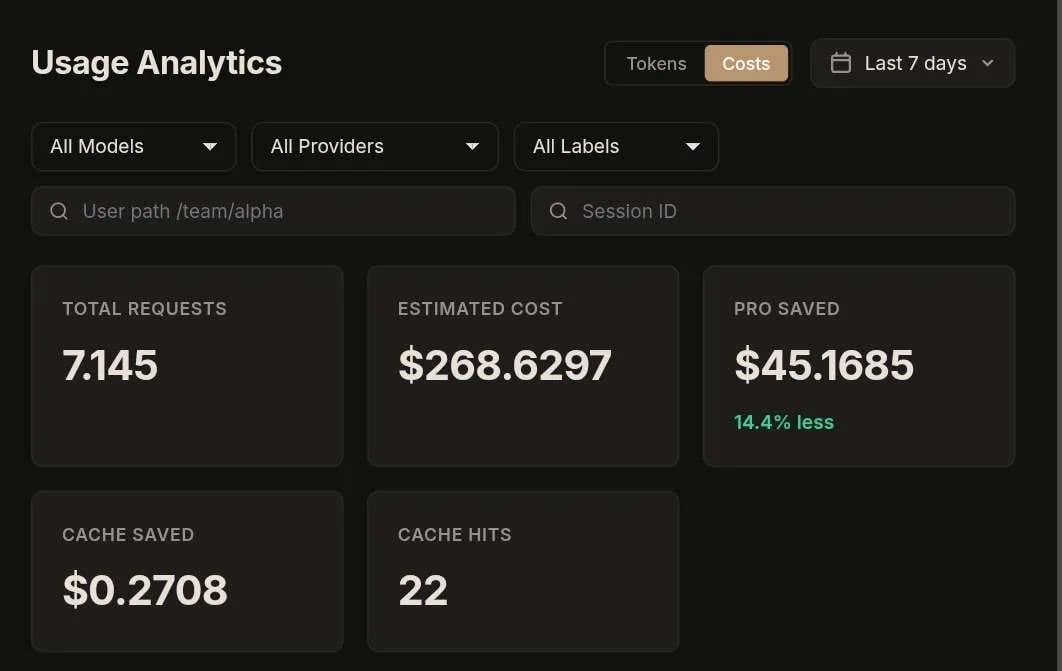
Dashboard Usage page: Pro savings over seven days of production traffic.
Proven in production
Prompt compression has been exercised on billions of production tokens across agentic coding, chat, and tool-heavy workloads.- Lossless. Compression only replaces content the model has already seen in the same request with a reference to it, or re-encodes structured data reversibly. The model receives the same information; nothing is summarized or dropped. The single lossy option, tool-result pruning, is a separate policy that is off by default.
- No prompt-cache degradation. Because the previously sent prefix of a session is replayed byte-for-byte and only new messages are rewritten, provider prompt caches keep hitting across turns. Testers actually noticed about a 2% increase in prompt-cache hits, since shorter, more stable requests fit the cache better — which adds savings on top of the compression itself.
- Real savings of 2%–20% of input tokens for our testers, depending on the use case. Agents that re-read files, replay tool output, or carry long histories sit at the top of that range; short, non-repetitive chat sits at the bottom, where the compressor simply forwards requests unchanged.
- Full control. Choose the level per gateway or per request, exclude
models by glob, protect pre-existing history with
new_messages_only, keep source code verbatim, and inspect every rewrite through response headers, audit revisions, and metrics.
Overview
Prompt compression rewrites supported inference requests before they reach the provider. It reduces repeated or structural context while preserving the request’s non-text structure. It supportsPOST /v1/chat/completions, POST /v1/messages, and
POST /v1/responses. Tool-call arguments, non-text parts, and unknown JSON
fields are left intact. Responses reasoning items are always replayed
unchanged, because the Responses API can require them alongside function calls.
The default high policy combines line-run deduplication with normalization:
- file-read line-number gutters become a compact range header
- replayed chat-completions reasoning is removed when it is safe to do so
- known tool-result envelopes, search results, logs, JSON, and unified diffs use content-aware normalization
- profitable homogeneous JSON arrays and structured logs use reversible, self-describing encodings
new_messages_only when the gateway may join a conversation whose
prefix it did not observe.
Configure compression
Set
PRO_COMPRESSION_LEVEL=none to disable compression for the whole
gateway. For one request, send:
none level bypass request-body parsing, so
the request is forwarded unchanged.
Inspect compression
Compressed responses include estimated savings and the number of replaced duplicate blocks:LOGGING_LOG_BODIES=true. Prometheus metrics use the
gomodel_pro_compression_ prefix, and the Dashboard Usage page reports Pro
savings in tokens or cost.